

How do you protect a public space from a threat that remains invisible until it is too late? For years, the evidentiary gap in drug-facilitated crimes has left institutions vulnerable and victims without recourse. It's a systemic failure. Modern residual drug testing technology addresses this by transforming hidden environmental hazards into immediate, actionable data.
You already know that waiting weeks for laboratory toxicology results isn't a viable defense against high-potency synthetic opioids. This briefing provides the framework to implement forensic-grade safety protocols that serve as a visible deterrent and protect your institutional reputation. We will examine the 2026 global standards for surface detection, the impact of the Tennessee Drink-Spiking Prevention Act, and the shift toward portable, field-ready forensic validation. Visibility is the only path to safety.
Key Takeaways
- Bridge the evidentiary gap. It's time to move from slow, reactive laboratory cycles to proactive, forensic-grade field detection.
- Deploy high-sensitivity reagents via residual drug testing technology to identify invisible environmental threats instantly on surfaces and belongings.
- Integrate the "Safety Continuum" into institutional protocols to transform safety from a hidden concern into a visible, verifiable standard.
- Utilize field-deployable tools like DrugDetective to establish a powerful deterrent that protects your reputation and shifts perpetrator behavior.
The Evolution of Residual Drug Testing Technology
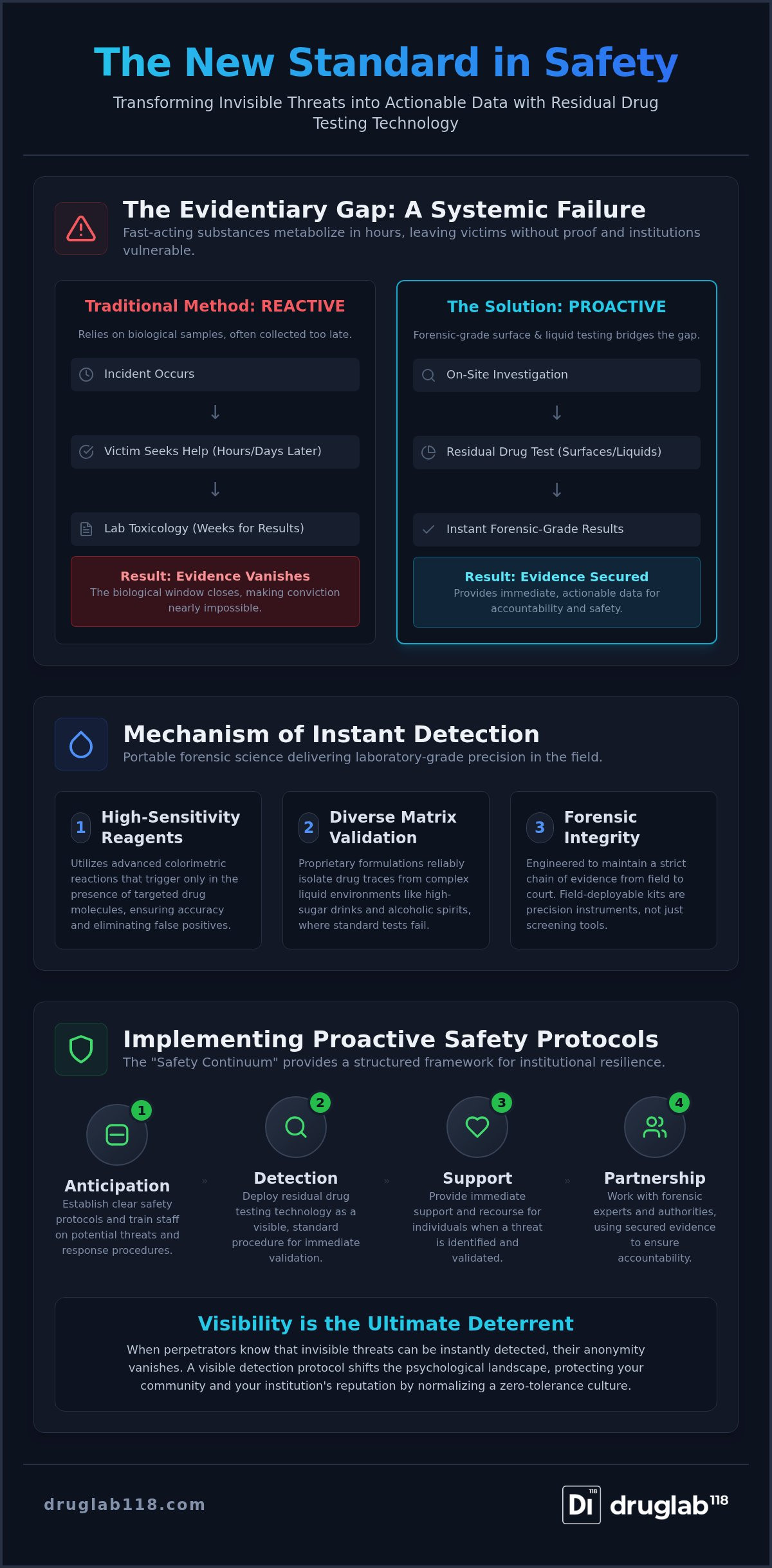
Residual drug testing technology is the precise identification of trace chemical signatures on environmental surfaces, personal belongings, and within liquid matrices. It represents a forensic evolution. Traditionally, safety protocols relied almost exclusively on biological samples. These methods are reactive. They wait for a victim to be harmed before seeking evidence in blood or urine. This delay is no longer acceptable in a landscape of high-potency synthetic threats.
The industry is shifting toward proactive, field-deployable detection. By identifying illicit substances before ingestion or during an immediate site investigation, institutions move from crisis management to active prevention. Making detection visible serves a dual purpose. It validates the threat with clinical accuracy and acts as a psychological deterrent. Making the invisible visible is the only way to change behavior and ensure systemic safety.
The Evidentiary Gap in Substance Exposure
The evidentiary gap is a clinical reality. It's a failure of timing. Many fast-acting substances, such as designer benzodiazepines or synthetic opioids, metabolize within hours. This creates a devastating evidentiary gap and spiking conviction rates remain historically low because the biological window closes before a victim can even seek help. The evidence vanishes from the body while the crime remains unpunished.
Surface and liquid testing provides the immediate proof that traditional laboratory toxicology often misses. Utilizing surface drug residue tests allows safety partners to secure forensic evidence directly at the scene. This immediate validation bridges the gap between a suspected incident and actionable data. It provides the forensic integrity required for institutional accountability and the protection of public health. We don't just find substances; we provide the truth when time is against us.
Mechanisms of Instant Forensic-Grade Detection
Modern forensic science has moved beyond the bench. High-sensitivity reagents now allow for the identification of illicit substances without the burden of heavy laboratory equipment. This isn't just convenience; it's a necessity. Identifying high-potency contaminants like synthetic opioids or nitazenes on surfaces requires chemistry that is both specific and incredibly sensitive. Our residual drug testing technology utilizes advanced colorimetric reactions that trigger only in the presence of targeted molecular structures. This ensures that field results remain accurate under high-stakes conditions. It's about precision. It's about speed.
Forensic integrity is the cornerstone of this process. Field-deployable kits like DrugDetective are engineered to maintain a strict chain of evidence. They aren't mere screening tools; they are precision instruments. By providing instant validation, safety partners can secure a scene or protect an individual before a threat escalates. This level of residual drug testing technology empowers institutions to act with confidence. If you're looking to upgrade your safety protocols, you can explore our forensic-grade detection solutions.
High-Sensitivity Reagents and Liquid Matrices
Identifying contaminants in complex beverage environments, such as high-sugar sodas or alcoholic spirits, presents a unique chemical challenge. The matrix often interferes with standard tests. Technical validation is required to ensure that liquid drug detection technology remains reliable across diverse environments. Through our strategic partnership with SureScreen Diagnostics, DrugLab118 has developed proprietary formulations that isolate drug molecules from liquid interference. This partnership brings twenty years of diagnostic leadership to the front lines. It ensures that every result, whether on a surface or in a drink, meets the highest standards of clinical reliability. We don't guess. We verify.
Implementing Residual Detection in Institutional Safety Protocols
Implementing safety isn't a single event. It's a continuum. The "Safety Continuum" includes Anticipation, Detection, Support, and Partnership. This framework provides the structure for institutional resilience. By integrating residual drug testing technology into daily operations, partners move beyond passive monitoring. They create a proactive shield. This systemic approach ensures that every stakeholder understands the protocol. It replaces ambiguity with forensic certainty. It's about duty.
Visibility changes everything. In universities and hospitality venues, the mere presence of detection tools shifts the psychological landscape. Perpetrators rely on the "invisible" nature of their actions. When residual drug testing technology is deployed as a visible, standard procedure, that anonymity vanishes. It's a powerful deterrent. By normalizing safety, institutions signal a zero-tolerance culture that protects both their reputation and their people. Truth is the best defense.
The Roadmap for Safety Normalization
Transitioning to a forensic-grade environment requires a methodical approach. It begins with assessment and ends with systemic integration. Partners should follow this three-step roadmap to ensure consistency:
- Step 1: Assess environmental risk factors in high-traffic venues to identify "blind spots" where substances are frequently handled or transferred.
- Step 2: Deploy visible detection tools to signal a zero-tolerance culture. Visible kits act as a constant, silent guardian against illicit activity.
- Step 3: Integrate forensic data into institutional safety briefings to standardize response protocols and ensure all staff act with clinical precision.
For those seeking to lead their industry, we offer a strategic roadmap for private label forensic detection. This ensures that your safety standards are as unique as your brand. We don't just provide tools. We build partnerships for a safer global standard. Protection is a shared responsibility.
Securing the Future of Institutional Safety
The transition from reactive monitoring to proactive protection is a moral and clinical necessity. We've established that the evidentiary gap can only be bridged through immediate, visible validation. By integrating residual drug testing technology into your standard safety protocols, you transform invisible threats into observable data. This isn't just about detection; it's about shifting perpetrator behavior and establishing a zero-tolerance culture. With twenty years of leadership in forensic diagnostics, we deliver forensic-grade results instantly where they matter most. We're trusted by universities and global hospitality partners to maintain the highest standards of public health. It's time to lead. Partner with DrugLab118 to normalize safety through forensic detection and ensure your institution remains a definitive sanctuary of reliability. Together, we can make safety the global standard.
Frequently Asked Questions
How does residual drug testing technology differ from traditional lab tests?
Residual drug testing technology differs from traditional laboratory toxicology by focusing on the environment rather than biological samples. While lab tests are reactive and often require days for results, it doesn't wait for a victim to be harmed. It provides instant, forensic-grade validation on surfaces and in liquids. This allows institutions to identify threats immediately. It eliminates the delay that leads to lost evidence.
Can residual detection technology identify synthetic opioids on surfaces?
Yes, modern residual drug testing technology is specifically engineered to identify high-potency synthetic opioids on environmental surfaces. By utilizing specialized reagents developed in partnership with SureScreen Diagnostics, these tools detect trace amounts of substances like nitazenes or fentanyl. This capability is vital for protecting staff from accidental exposure. It ensures that even microscopic residues become visible and actionable.
Is forensic-grade field testing admissible for institutional safety protocols?
Forensic-grade field testing is a foundational component of modern institutional safety protocols. While it isn't a replacement for judicial evidence, it provides the immediate, verified data required for internal disciplinary actions and site management. By standardizing response through institutional briefings, organizations ensure that every detection event is handled with clinical precision. This creates a documented record of safety compliance and risk mitigation.
How does visible drug testing change behavior in hospitality venues?
Visible drug testing changes behavior by removing the anonymity that perpetrators rely on. When detection becomes a standard, observable part of the hospitality environment, it's a powerful psychological deterrent. It signals a zero-tolerance culture. By normalizing safety through visible protocols, venues shift the responsibility of protection from the individual to the institution. This proactively reduces the likelihood of drug-facilitated crimes.


