

Visible testing alone won’t protect a patron or resolve a venue’s responsibilities after suspected drink spiking. Strong venue drink spiking prevention protocols connect documented prevention with a consistent staff response and appropriate support. That matters when local requirements vary and employees may be unsure what to do next.
Venue leaders need a framework that works during a busy shift, not measures that look reassuring on paper. This article explains how to document procedures, clarify the roles of staff and managers, and coordinate with appropriate responders. It also considers visible detection as one part of a wider safety culture. Detection can make an unseen risk more actionable, but it doesn’t replace humane support, established procedures, or jurisdiction-specific legal advice. The goal is a coordinated approach that strengthens preparedness without promising immunity from liability.
Key Takeaways
- Assess venue liability as a jurisdiction-specific legal question, and distinguish operational risk management from legal advice.
- Build venue drink spiking prevention protocols around clear staff roles, a defined escalation route, patron support, and proportionate incident records.
- Give staff a practical sequence to follow, from the first concern raised through manager involvement and appropriate next steps.
- Consider visible drink detection as one element of a wider safety approach, not a replacement for trained staff, support, or established procedures.
How drink-spiking incidents can create liability concerns for venues
Venue liability is a jurisdiction-dependent legal question, not a single rule that applies to every bar. After suspected drink spiking, a review may consider what risks were foreseeable, what precautions the venue had in place, whether staff knew how to respond, and how the concern was handled. The relevance of each factor depends on local law and the circumstances.
For example, an incident record can show when a patron raised a concern, which manager was notified, what support was offered, and what actions followed. It doesn’t prove that the response was legally sufficient, and a missing record doesn’t by itself establish liability. Well-designed venue drink spiking prevention protocols connect day-to-day practice with clear management oversight, so staff aren’t left to improvise under pressure.
Protocols support responsible practice, but they can’t guarantee immunity from liability or prevent every incident.
Which legal duties should bar managers verify locally?
Managers should have qualified local counsel review the rules and obligations that may apply to their premises, licence, patrons, and incident response. Don’t assume requirements in one jurisdiction apply elsewhere.
- Premises and licensing: Review relevant venue-safety conditions, licence terms, and rules specific to the establishment.
- Safeguarding and reporting: Clarify how local law addresses patron welfare, escalation, and whether particular incidents must be reported.
- Records and staff preparation: Confirm documentation and training expectations, including how privacy should be handled.
Use current primary sources, such as legislation, regulator guidance, or official licensing materials, alongside legal advice. Depending on the facts and jurisdiction, an incident could raise civil, regulatory, or reputational concerns; none is automatic. A documented process gives managers a basis for reviewing decisions, identifying gaps, and improving practice without treating a protocol as a substitute for legal advice.
Which drink-spiking prevention protocols make a venue’s response consistent?
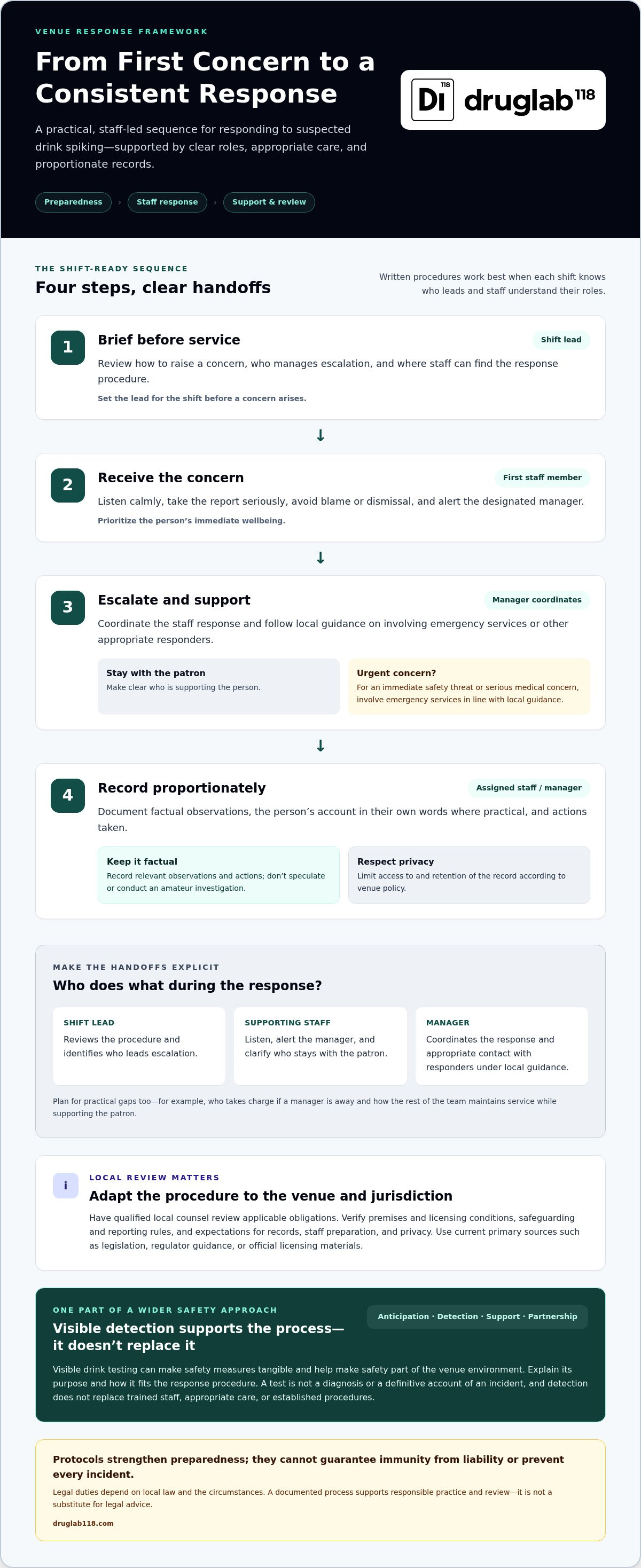
A useful protocol turns policy into actions people can follow during a busy shift. Venue drink spiking prevention protocols should be written, assigned by role, and adapted to locally reviewed requirements. Keep the procedure easy to find, and make sure each shift knows who leads the response.
- Brief before service: The shift lead reviews how to raise a concern, who is managing escalation, and where staff can find the response procedure.
- Receive the concern: Listen calmly, take the report seriously, and alert the designated manager without blaming or dismissing the patron.
- Escalate and support: The manager coordinates the staff response and follows local guidance on involving emergency services or other appropriate responders.
- Record proportionately: Document relevant observations and actions under venue privacy and retention policies. Don’t speculate or conduct an amateur investigation.
Be specific about who takes the lead on each shift, who stays with the patron, and who contacts responders. The City of Tempe’s Tempe Drink Spiking Prevention Program illustrates how local measures can include testing devices and signage; it isn’t a universal template. Check applicable rules against current local primary sources.
A written protocol is useful only when staff understand and rehearse their roles. Briefings and practice can reveal practical gaps, such as uncertainty about who takes charge when a manager is away or how the rest of the team maintains service while supporting the patron.
How should staff respond when someone reports a suspected spiking?
Prioritize the person’s immediate wellbeing. Listen without blame, communicate calmly, and follow the venue’s locally reviewed escalation procedure. If there’s an immediate safety threat or serious medical concern, involve emergency services in line with local guidance. Staff shouldn’t try to identify a substance or establish what happened themselves. Record factual observations, the person’s account in their own words where practical, and actions taken. Limit access to and retention of the record according to venue policy.
For venues developing a context-specific safety framework, DrugLab118’s institutional approach supports partnership focused on preparedness, detection, and a consistent response.
How can visible detection support a venue’s wider safety approach?
Visible drink testing can make safety measures tangible, but it works best within a wider framework of anticipation, detection, support, and partnership. When detection is visible, it can help change behaviour and make safety a normal part of the venue environment. It doesn’t replace staff readiness, a response procedure, or appropriate care.
DrugLab118 provides instant, forensic-grade detection of drugs and contaminants in drinks through its DrinkDetective kit. Venues can decide how to make detection visible in their setting, which staff can explain its role, and how it fits the response procedure. A test should not be presented as a diagnosis or a definitive account of an incident. This practical overview of drink-spiking detection kits explains how detection can form one visible layer of prevention rather than a stand-alone solution.
How should a venue assess detection within its safety plan?
Start with the operating context. Decide where detection can be made visible, which staff can explain its purpose, and how a concern moves from the bar floor to a manager and into the venue’s support process. The aim is integration: patrons should understand what the measure is for, and staff should know how it fits their responsibilities.
Detection results don’t replace medical assessment, laboratory toxicology, or legal advice. If someone feels unwell or may be at immediate risk, follow the venue’s response procedure and involve appropriate responders. Review the approach as risks, technology, and local expectations evolve. DrugLab118 works with venues as partners in a broader safety effort, combining detection with institutional briefings and a focus on preparedness.
Well-integrated visibility can strengthen venue drink spiking prevention protocols by connecting prevention with actionable detection and humane support. The measure matters, and so does the system around it.
Make safety a continuing commitment
Treat venue drink spiking prevention protocols as a living framework, reviewed as your venue, staff, and local expectations evolve. Consistent practice takes more than a written policy. It calls for leadership that keeps learning, listens to staff and patrons, and strengthens the response over time.
DrugLab118 brings twenty years of leadership to a collaborative safety mission through institutional briefings and partnership with venues. The aim is not to promise that every incident can be prevented, but to help make preparedness visible, practical, and responsive. Progress starts with shared responsibility.
Explore visible detection as part of a venue safety partnership and take a considered next step toward a safer, more prepared environment for patrons and staff.
Frequently Asked Questions
Can a bar be liable if a guest’s drink is spiked?
Possibly, but liability depends on the jurisdiction, the facts, and the venue’s conduct. A claim or review may consider the circumstances surrounding the incident and how the venue responded; no outcome is automatic. For example, a manager should know whom to notify if an incident leads to a formal complaint or legal correspondence. Seek advice from qualified local counsel about applicable duties and response obligations.
What should a bar do when a guest reports suspected drink spiking?
Take the report seriously and address the person’s immediate safety and comfort. If they’re confused or distressed, move the conversation away from a busy bar area and ask whom they’d like contacted, if appropriate. If they’re unresponsive or appear seriously unwell, follow local emergency guidance and call emergency services. Don’t pressure them to recount events publicly or speculate about what happened.
Do drink-spiking prevention protocols protect a bar from liability?
No. Venue drink spiking prevention protocols can help staff act consistently, but they don’t guarantee protection from a claim or determine how a legal matter will be resolved. A written policy alone may carry little weight if it doesn’t reflect actual practice. Managers can review whether shift briefings, staff understanding, and incident records align with the procedure, then address gaps with local legal advice.
Can drink testing kits replace staff training or emergency response?
No. A drink test can support detection, but it can’t assess someone’s health, provide medical care, or direct the venue’s full response. Staff still need to know how to handle a concern, communicate calmly, and involve appropriate responders when necessary. Treat testing as one tool within a wider safety plan, not as a reason to delay urgent assistance or dismiss reported symptoms.


