

Awareness is not readiness. Hospitality staff need more than a general warning about drink spiking. They need clear actions for responding when a guest raises a concern and a shared understanding of when to escalate. Effective hospitality staff drink spiking training turns awareness into a consistent venue response, without asking staff to make assumptions or act beyond their role.
This guide explains what practical training should cover and how managers can connect prevention, visible detection, guest support, and appropriate escalation. It also explores how tools such as DrinkDetective can make detection visible as part of a broader safety culture, alongside staff procedures and organizational partnership. The aim is readiness, not a one-off awareness session.
Key Takeaways
- Effective hospitality staff drink spiking training prepares teams to prevent risks where possible, respond to concerns, support guests, and escalate without promising that every incident or substance can be identified.
- Organize staff guidance around preparation, receiving a concern, immediate support, and escalation so employees know their role and who to inform.
- Reinforce training through consistent safety practices and team discussions, making visible detection part of the venue’s wider safety culture.
- Connect anticipation, detection, guest support, and organizational partnership to build a practical approach that can evolve over time.
What Should Drink Spiking Training Prepare Teams to Do?
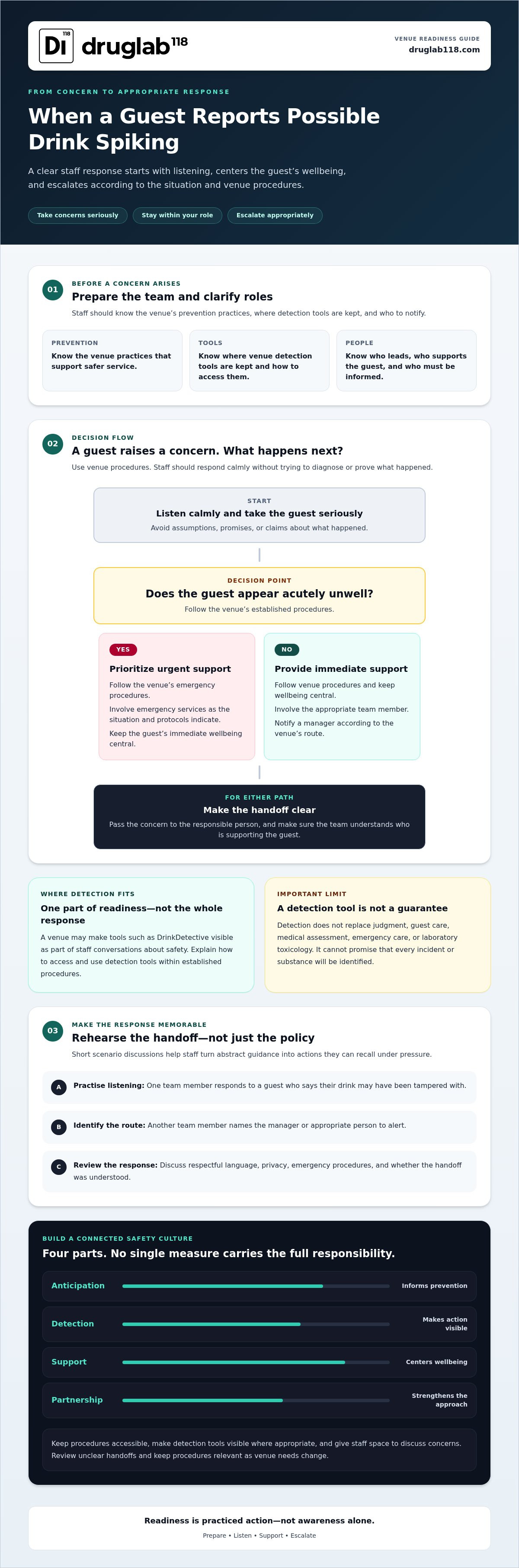
Effective hospitality staff drink spiking training prepares teams to prevent risks where possible, respond to concerns, support guests, and escalate appropriately. It goes beyond describing the threat. Staff need to know what they can do within their role, how to communicate a concern, and when to involve a manager or emergency services.
Drink spiking can involve adding a substance, including alcohol, to someone’s drink without their knowledge or consent. The term has a longer cultural history, explored in this overview of the history of drink spiking. Training should make the modern response clear without suggesting staff can prevent every incident or identify every substance.
Why awareness alone may not prepare a venue team
Knowing that spiking is a risk is not the same as knowing what to do when a guest reports a concern. Without practical guidance, staff may hesitate, respond inconsistently, or assume a visible sign proves what happened. Set a clear standard: effective training turns awareness into practiced actions for prevention, support, and escalation.
Visible detection can make safety practices observable and easier to discuss. For example, a venue can include DrinkDetective in staff conversations about how detection fits into its wider response. A detection tool is one part of readiness, not a guarantee or a substitute for judgment, guest care, or escalation.
- Prevent: Understand the venue practices that support safer service.
- Recognize: Take a guest’s concern seriously without trying to diagnose or prove what happened.
- Support: Keep the person’s immediate wellbeing central and follow venue procedures.
- Escalate: Know who to notify and when emergency help is needed.
Detection supports a safety response. It does not replace medical assessment, emergency care, or laboratory toxicology. Readiness means acting promptly and responsibly within those limits.
How Can Venues Structure Practical Drink Spiking Training for Staff?
Make hospitality staff drink spiking training a sequence employees can recall under pressure, rather than a policy they hear once and forget. Managers can adapt these steps to the venue’s procedures. Make clear who takes the lead, who supports the guest, and how team members pass on information.
- Prepare: Review prevention practices, where detection tools are kept, and who staff should notify.
- Receive a concern: Listen calmly, take the guest seriously, and avoid assumptions or promises.
- Provide immediate support: Follow venue procedures, keep the guest’s wellbeing central, and involve the appropriate team member.
- Escalate: Contact a manager or emergency services as the situation and established protocols indicate.
Mass.gov’s guidance on how venues can prevent drink spiking can inform discussion of practical prevention and intervention. Translate guidance into clear internal communication routes, and specify responsibilities so staff know who handles each step.
What practical actions should training cover?
Use short scenario discussions to rehearse responses. For example, one team member can practise listening to a guest who says their drink may have been tampered with, while another identifies the manager to alert. Discuss respectful language, privacy, and how to follow the venue’s emergency procedures if the person appears acutely unwell. Then review the handoff: did the person know whom to tell, and did the team understand who was supporting the guest? Rehearsal turns abstract guidance into actions staff can remember.
Include detection, but never treat it as the whole response. Explain how staff can access and use venue detection tools within established procedures, and review the drink spiking detection kit guide for further context. For broader organizational learning, explore DrugLab118’s detection and safety resources.
How Can Drink Spiking Training Become Part of a Venue’s Safety Culture?
A training session has lasting value when its principles are visible in everyday venue practice. Managers can reinforce them by keeping response procedures accessible, making detection tools visible where appropriate, and giving staff space to discuss concerns after a shift. Consistency matters: guests and employees should see safety as part of how the venue operates, not a message that appears only during training.
Build the approach as a connected continuum. Anticipation informs prevention; detection makes safety action more visible; support keeps guest wellbeing central; and partnership helps the venue strengthen its approach. No single measure carries the full responsibility. Use team discussions to identify unclear handoffs and keep procedures relevant to how the venue actually works.
From a one-off session to ongoing partnership
Risks and detection methods can evolve, so hospitality staff drink spiking training should remain an active part of safety planning. Review procedures as the venue’s needs change, invite staff to raise practical questions, and treat continual innovation as essential to keeping safety measures relevant.
DrugLab118’s institutional briefings educate organizations on substance detection and safety protocols, supporting a broader conversation about preparedness and partnership. For organizational context, read about the institutional substance safety briefing. A sustained safety culture connects informed people, visible detection, and a clear support response. To consider how these elements work together, explore DrugLab118’s safety approach.
Turn Staff Readiness Into Everyday Venue Practice
Strong hospitality staff drink spiking training equips teams to move from awareness to consistent action: prepare for concerns, respond respectfully, support guest wellbeing, and escalate through venue procedures. Visible detection belongs within that response, not in place of it. Regular team discussions help keep practices clear and relevant.
Safety is strongest when anticipation, detection, support, and partnership work together. DrugLab118 identifies hospitality venues as partners and brings twenty years of leadership, as stated in its company manifesto, to its work. Its institutional briefings also support education on substance detection and safety protocols, helping organizations build understanding as risks and solutions continue to evolve.
Explore DrugLab118’s approach to visible detection and safety to consider how detection tools and institutional briefings can support your venue’s wider safety work.
Frequently Asked Questions
What should hospitality staff do if a guest thinks their drink was spiked?
Take the concern seriously, listen without blame, and notify the manager according to venue procedures. If the guest appears seriously unwell, confused, or unable to remain safe, call emergency services and follow established response steps. Keep someone with them, protect their privacy, and avoid offering a diagnosis. Detection tools may support the response, but they do not replace medical assessment or emergency care.
Can drink spiking training prevent every incident?
No. Training can improve staff readiness and help teams respond more consistently, but no session or detection tool can guarantee that every incident will be prevented or every substance identified. Set realistic expectations, practise the venue’s response, and make roles clear. Treat detection as one element in a safety approach that also includes prevention, guest support, and appropriate escalation.
What should drink spiking awareness training for bar staff include?
Drink spiking awareness training for bar staff should turn risk recognition into role-specific actions. Cover prevention practices, how to receive a guest’s concern respectfully, immediate support, internal reporting routes, and when to follow emergency procedures. Use brief scenarios to practise handoffs between floor staff, supervisors, and managers. Include visible detection tools as one supporting measure, with clear limits and instructions.
How can a hotel or bar make drink spiking training part of everyday practice?
Make drink spiking readiness part of routine operations by reviewing response procedures in team meetings and using short scenario discussions to practise communication and handoffs. Managers can keep detection tools visible and ensure staff know how they fit into established procedures. Invite staff to raise uncertainties, then clarify internal roles and update guidance as venue practices evolve.


