

Could a drink test that detects GHB tell you anything about Rohypnol? Not unless the manufacturer’s instructions explicitly name Rohypnol, also known as flunitrazepam, as a target. Check the label and product documentation rather than assuming one test covers another substance.
It’s understandable to want a quick check when drink safety is in question. But a negative result doesn’t prove a drink is safe: a test screens only for the substances it lists, using the sample types and conditions specified by its manufacturer. A positive screening result isn’t laboratory confirmation or forensic evidence, either.
This guide explains what to verify before buying rohypnol test strips, how to interpret screening results without overstating what they mean, and what to do if exposure may have occurred. You’ll learn how to compare a product’s stated targets and limitations, and why suspected drugging calls for getting to safety and seeking immediate medical help, not relying on a strip alone.
Key Takeaways
- Before buying rohypnol test strips, check that the product documentation names Rohypnol or flunitrazepam as a target.
- Match the test’s intended sample and instructions to how you plan to use it. Don’t assume claims apply outside those conditions.
- Look for clear manufacturer information about limitations and supporting evidence. Verify performance or timing claims in current documentation rather than taking them at face value.
- If exposure or symptoms are a concern, prioritize immediate safety and professional medical help instead of waiting for a screening result.
What Rohypnol Test Strips Can, and Cannot, Tell You
A drink test strip is a screening product intended to indicate whether one or more specified substances may be present in a sample. Its usefulness depends on the targets named by the manufacturer and on following the instructions for the sample being tested. A product marketed for drink spiking does not necessarily test for every drug that could be involved.
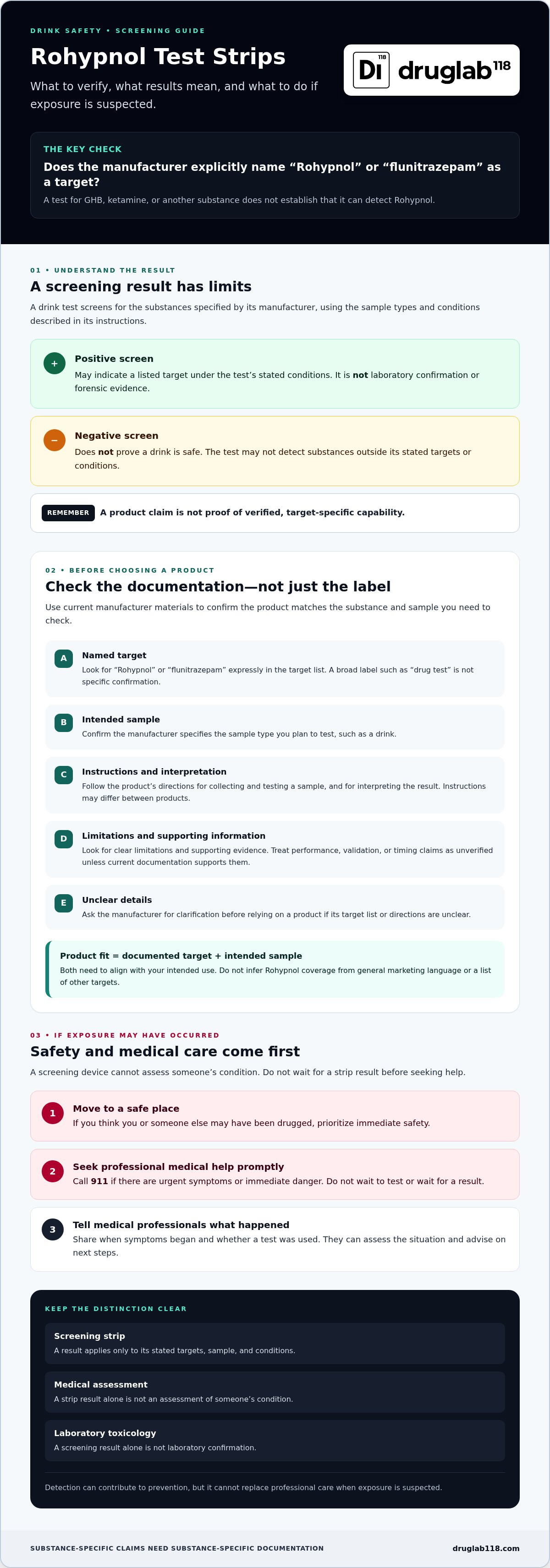
Keep the distinction clear: a product claim is not proof of verified, target-specific capability. Check the manufacturer’s current documentation for the substances detected and the sample types covered. A result can speak only to the test’s stated targets and conditions, not to substances it was not designed to detect.
Does a drink test specifically detect Rohypnol?
Look for “Rohypnol” or “flunitrazepam” explicitly in the manufacturer’s target list. Flunitrazepam is the chemical name associated with Rohypnol; see this overview of Flunitrazepam (Rohypnol). A broad label such as “drug test” doesn’t tell you which substances the product detects. A test for another substance, such as ketamine or GHB, does not establish that it can detect Rohypnol.
When comparing rohypnol test strips, don’t infer coverage from general marketing language or a list of different targets. DrugLab118 develops detection solutions, but its available product information does not confirm a Rohypnol-specific strip or detection capability. Before relying on a product for this purpose, verify the claim in the manufacturer’s current documentation.
How to Evaluate Rohypnol Test Strips Before Buying
Compare the product documentation, not just its name or headline claim. Before choosing rohypnol test strips, check that the instructions fit the situation and that the manufacturer provides enough detail to assess what the test is designed to detect. For broader context on detection approaches, see this drink-spiking detection kit guide.
Which product details should you verify?
- Named target: Check that Rohypnol or flunitrazepam is expressly listed as a detected substance. Don’t treat a general claim as confirmation.
- Intended sample: Confirm that the manufacturer specifies use with the type of sample you plan to test, such as a drink.
- Instructions: Read how to collect and test the sample, and how to interpret the result. Instructions for one product may not apply to another.
- Limitations: Look for factors that may affect interpretation and clear explanations of what a negative or positive screen means.
- Documentation and support: Review current manufacturer materials. If the target list or directions are unclear, ask the manufacturer for clarification before relying on the test.
A product is a match only when its documented target and intended sample align with your need. Treat performance, independent validation, and result-timing claims as unverified unless current documentation supports them. The DEA Rohypnol fact sheet offers authoritative background on the substance, but it does not validate a particular test.
DrugLab118 develops detection solutions, but its available information does not confirm a Rohypnol-specific strip. For more about its drug and contaminant detection solutions, review the company’s information directly.
What to Do After a Possible Rohypnol Exposure
If you think you or someone else may have been drugged, move to a safe place and seek professional medical help promptly. Call 911 if there are urgent symptoms or immediate danger. Don’t wait to use rohypnol test strips or for a result before getting help. A screening device cannot assess someone’s condition and should not delay care.
Tell medical professionals what happened, when symptoms began, and whether a test was used. They can assess the situation and advise on appropriate next steps. A strip result alone is not a medical assessment or laboratory toxicology confirmation. Even an apparently negative result cannot rule out exposure to a substance the test doesn’t detect or a problem it wasn’t designed to identify.
How should a screening result guide your next step?
Follow the manufacturer’s specific instructions for the sample, procedure, and result interpretation. Treat an unclear or unverified result cautiously, and never use it as proof that a drink or person is safe. For broader information about detection methods, see this overview of rapid narcotic identification. It provides context, not confirmation of Rohypnol exposure.
DrugLab118 provides instant detection solutions and works with institutional partners as part of a broader safety approach. It does not provide medical treatment or laboratory toxicology. Detection can contribute to prevention, but it cannot replace professional care when exposure is suspected. Institutions considering detection approaches can explore DrugLab118 detection solutions as part of a partnership discussion.
Choose Detection with Clear, Verified Scope
Before buying rohypnol test strips, verify that the manufacturer explicitly names Rohypnol or flunitrazepam for the sample you intend to test. A screening result has limits: it cannot establish that a drink is safe or replace medical assessment. If exposure is suspected, prioritize safety and professional help.
Detection is one part of a broader safety response. Drug Lab 118 describes its work as instant, forensic-grade detection of drugs and contaminants in drinks, on surfaces, and on personal belongings. The company works in partnership with universities, hospitality venues, event organisers, and public-safety organisations. Its available information does not confirm a Rohypnol-specific strip, so don’t assume that capability.
For institutions considering detection as part of a collaborative safety approach, discuss a detection partnership with Drug Lab 118. Clear product claims and informed decisions help make visible safety measures more meaningful. Contact Drug Lab 118 to discuss detection solutions for your organisation.
Frequently Asked Questions
Do Rohypnol test strips detect flunitrazepam?
Some may, but only if the manufacturer explicitly lists flunitrazepam or Rohypnol as a detected target for the intended sample. Check the current product documentation rather than relying on a broad “drug test” claim. The substance name or product category alone doesn’t verify that a particular strip can detect it.
Can a drink test prove that Rohypnol was added to a drink?
No. A drink test is a screening tool, not definitive proof of what happened. A result may indicate a substance the test is designed to detect, but it doesn’t establish who added it or when. A screening result is not laboratory confirmation or a medical assessment. If exposure is suspected, seek professional help rather than relying on a strip alone.
Are all drink-spiking test strips designed to detect Rohypnol?
No. Drink-spiking tests can have different target lists, and some are designed to screen for substances other than Rohypnol. Check the manufacturer’s documentation for named targets, intended sample, instructions, and limitations. A product that detects another drug does not thereby confirm Rohypnol detection, even if its marketing uses broad terms such as “spiking test.”
What should I do if I suspect a drink was spiked?
Move to a safe place and seek prompt professional medical help; call 911 if there’s immediate danger or urgent symptoms. Don’t wait for a test result. Tell medical professionals what happened and when. Even a negative result from rohypnol test strips cannot rule out exposure to substances the product doesn’t detect, so don’t treat it as proof of safety.


