

The paper strip resting beside a cocktail might offer quick comfort, but unregulated consumer novelties often collapse under the reality of complex beverage chemistry. When acidic mixers and high-proof ethanol trigger false positives or completely mask illicit sedatives, venue safety breaks down. You already know that protecting patrons demands decisive, verifiable certainty. Yet distinguishing between unverified paper strips and laboratory-backed date rape drug test kits remains a persistent challenge for hospitality leadership. False security is dangerous.
You will learn how forensic-grade diagnostic chemistry overcomes beverage matrix interference, discover clear criteria to evaluate analytical accuracy, and master visible testing protocols that actively deter drink-facilitated assault without disrupting operations. Here is how institutional operators replace cosmetic novelties with verified forensic standards.
Key Takeaways
- Explore how beverage matrices like high ethanol concentrations, dark tannins, and acidic citrus corrupt standard reagents, and why overcoming these chemical variables is essential for reliable field screening.
- Discover the critical diagnostic criteria that separate legally defensible date rape drug test kits from commercially unregulated novelty strips prone to false readings.
- Examine the diagnostic parameters required for instant colorimetric assays to deliver unambiguous, seconds-fast identification of illicit compounds under real-world venue lighting.
- Learn how implementing an integrated safety continuum transforms physical test deployment into a visible behavioral deterrent across universities, festivals, and hospitality settings.
The Science of Date Rape Drug Detection in Liquid Matrices
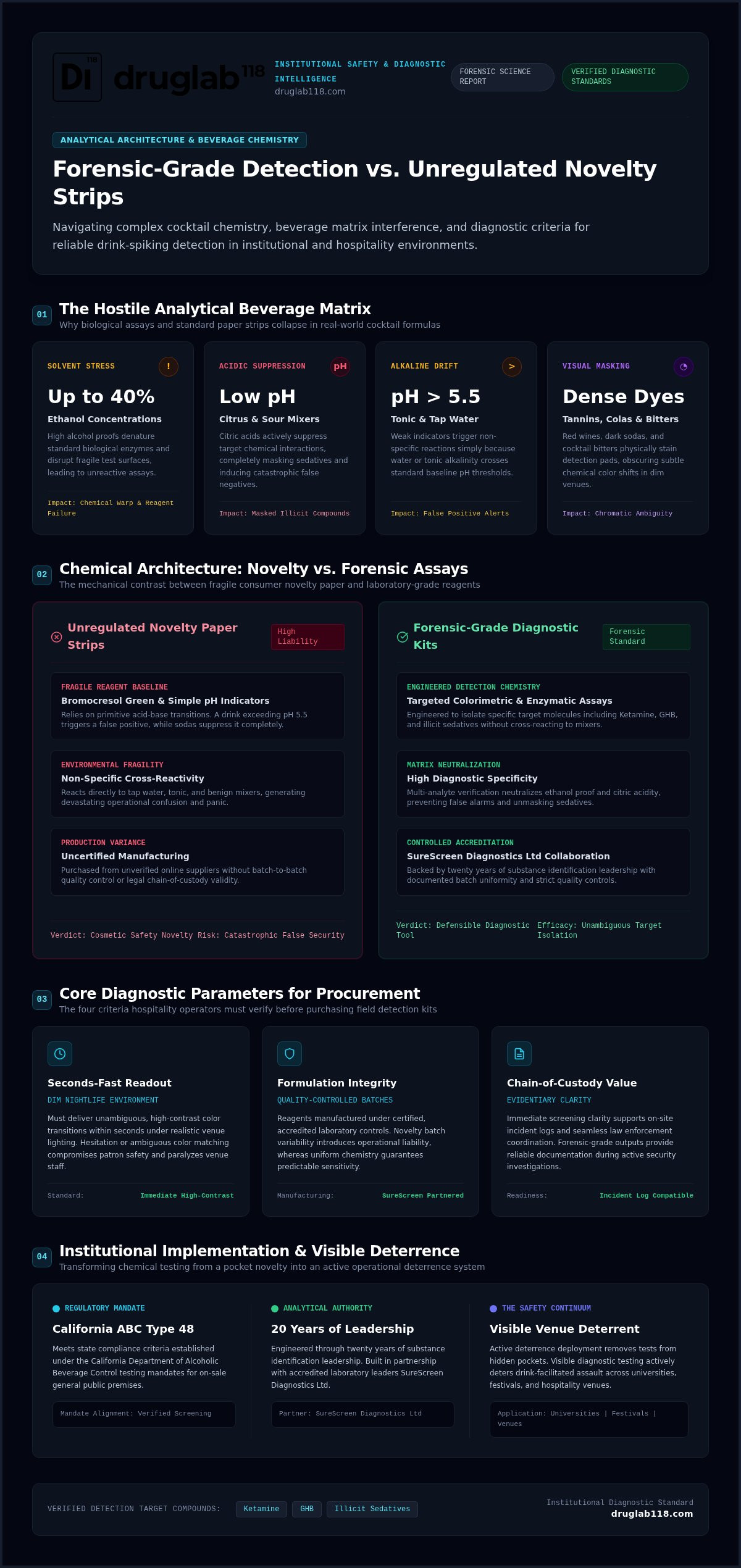
Field detection requires unyielding chemical stability. Professional date rape drug test kits rely on colorimetric and enzymatic reagents engineered to identify specific target molecules such as ketamine, GHB, and illicit sedatives. Identifying these compounds in a controlled water sample is straightforward. Real-world nightlife, however, presents a hostile analytical environment. Complex beverage matrices feature ethanol concentrations up to forty percent, low pH citrus juices, intense food colorings, and dense sugars. These variables can warp standard chemical reactions. Without advanced chemical engineering, basic assays produce catastrophic misreadings.
A compromised test creates severe liability. Standard clinical assays designed for biological fluids fail when introduced to dynamic cocktail formulas. For reliable field intervention, testing mechanisms must withstand diverse liquid properties:
- Extreme Acidity: Citrus mixers suppress standard chemical interactions, causing false negatives.
- Alkaline Baselines: Tonic water and soda water mimic drug reactions on weak pH indicators.
- Chromatic Interference: Red wines, colas, and dark bitters obscure visual color transitions.
Overcoming Matrix Interference in Real-World Beverage Screening
Novelty paper strips frequently fail because they rely on fragile pH indicators like bromocresol green. In peer-reviewed forensic evaluations, these basic indicators triggered non-specific reactions in standard tap water and tonic simply because the liquid pH exceeded 5.5. Simultaneously, citric acids in sodas completely masked illicit substances. Reliable screening requires sophisticated multi-analyte verification capable of isolating date rape drugs without cross-reacting against mixers, alcohol, or tannins. Understanding this diagnostic complexity is why establishing a rigorous forensic standard for drink spiking detection remains essential for protecting public venues from devastating diagnostic blind spots.
Evaluating Date Rape Drug Test Kits: Critical Diagnostic Standards
Procuring field detection technology requires strict diagnostic scrutiny. Substandard novelty products flooding online marketplaces provide an illusion of safety without analytical rigor. In contrast, forensic-grade date rape drug test kits must demonstrate high diagnostic specificity, isolating illicit substances from benign cocktail ingredients without ambiguous results. Deployment devices must deliver unmistakable colorimetric reactions within seconds under dim venue lighting. Hesitation costs safety. Institutional leaders cannot afford ambiguous color transitions when assessing an active safety breach or coordinating with local authorities.
When selecting deployment tools for commercial or municipal safety programs, decision-makers must demand clear diagnostic thresholds:
- Unambiguous Readouts: Immediate, high-contrast visual confirmations engineered for low-light environments.
- Formulation Integrity: Reagents manufactured under strict quality controls to guarantee uniform batch reliability.
- Chain-of-Custody Value: Immediate screening clarity that supports on-site incident logs and seamless law enforcement handoffs.
Differentiating Professional Forensic Tools from Unregulated Novelty Strips
Deploying novelty consumer cards invites severe operational liability. Unregulated paper tests lack certified manufacturing consistency, producing variable results across identical batches. Meeting institutional obligations, such as the California Department of Alcoholic Beverage Control testing mandates for Type 48 licensed premises, requires dependable tools engineered through twenty years of substance identification leadership. Established manufacturing partnerships with accredited leaders like SureScreen Diagnostics Ltd ensure chemical stability under real operating conditions. Selecting verified formulations guarantees seamless alignment with institutional protocols for rapid response drug testing. To safeguard patrons and uphold institutional compliance, organizations can partner with DrugLab118 to implement validated screening assets.
Operationalizing Visible Testing in Institutional and Hospitality Settings
Detection tools cannot function as secret safety blankets tucked inside pockets. When diagnostic kits remain hidden, predatory behavior continues unchecked. Making detection visible fundamentally alters the social environment. It signals an immediate, measurable risk to anyone attempting drink tampering. Visible protocols replace passive surveillance with active, physical deterrence. Data indicates that licensed venues visibly displaying physical detection tools experience an estimated 25 percent reduction in spiking incidents. When detection becomes visible, behavior changes. Safety becomes normal.
A comprehensive deterrence strategy extends beyond bar tops. Establishing an unyielding safety posture across higher education campuses, municipal nightlife districts, and festivals requires a continuous institutional framework:
- Anticipation: Evaluating environmental risk factors and establishing clear bar-service testing touchpoints.
- Detection: Supplying verified screening tools capable of immediate identification.
- Support: Instituting rapid escalation channels that care for affected patrons without causing panic.
- Partnership: Aligning venue operators, student unions, and civic authorities in a unified safety framework.
Establishing Active Deterrence Through Visible Safety Infrastructure
Treating frontline workers as active diagnostic defenders drives prevention. Hospitality staff trained in early intervention are 60 percent more likely to disrupt spiking attempts before harm occurs. Integrating visible date rape drug test kits directly into service counters establishes a continuous psychological barrier. Through dedicated solutions like DrinkDetective and DrugDetective, DrugLab118 equips partners across hospitality, festivals, and universities with instant screening assets across drinks, surfaces, and personal belongings. Backed by specialized Institutional Briefings, operators establish transparent deterrence while preserving venue energy.
Transforming Nightlife Safety Through Forensic Deterrence
Passive safety measures are no longer sufficient. Relying on unregulated novelties introduces severe operational liability when complex beverage chemistry distorts results. Protecting public environments demands verified diagnostic specificity, rapid visual clarity, and active procedural visibility. When establishments replace hidden screening tools with visible, forensic-grade date rape drug test kits, predator calculus breaks down. Real deterrence takes hold.
Backed by twenty years of substance identification leadership and chemical formulations developed in direct partnership with SureScreen Diagnostics Ltd, proven deployment models are already safeguarding universities, municipal bodies, and global event organizers worldwide. Building a resilient culture of protection is entirely achievable when clinical science and institutional commitment align. Partner with DrugLab118 to deploy forensic-grade safety solutions across your venues today.
Frequently Asked Questions
How do date rape drug test kits detect illicit substances in drinks?
These field screening tools use specialized colorimetric and enzymatic reagents engineered to interact with specific target molecules upon contact. When a small droplet of liquid touches the test zone, illicit compounds trigger an immediate chemical reaction. This process produces a distinct, high-contrast visual color change within seconds, confirming or ruling out targeted contaminants without requiring complex laboratory machinery.
Can acidic beverages or mixers cause false positives on test strips?
Unregulated consumer test strips relying on simple pH-sensitive indicators frequently misread acidic citrus mixers, carbonated sodas, or neutral tonic waters. In contrast, forensic-grade formulations are specifically developed to isolate drug molecules directly. This rigorous chemical engineering neutralizes extreme liquid acidity, high ethanol levels, and dark cocktail colorings to prevent false positives and eliminate dangerous false negatives.
What substances are modern rapid drink detection kits designed to identify?
Modern date rape drug test kits target the primary illicit substances used in drug-facilitated assaults, notably ketamine, gamma-hydroxybutyric acid (GHB), and central nervous system depressants like benzodiazepines. Advanced forensic screening platforms also expand testing capabilities beyond liquid beverages, enabling rapid identification of traces on high-contact venue surfaces and personal belongings.
Why is visible on-site testing considered an effective behavioural deterrent?
Concealed personal testing leaves perpetrators unchecked because it operates in secret. Transitioning to prominent, counter-level detection protocols fundamentally shifts the venue dynamic. When predatory actors see staff actively equipped with rapid diagnostic tools, the risk of immediate discovery spikes dramatically. Making detection visible creates a tangible psychological barrier that actively discourages drink tampering before it begins.


