

What if a substance-safety meeting could do more than warn workers about impairment? The most useful workplace safety meeting topics on substance abuse clarify what employees should observe, how to report an immediate concern, and what happens next, without asking anyone to diagnose a coworker. A clear, respectful plan protects people and makes support easier to seek.
Practical guidance should fit real work conditions and workplace policy. This checklist helps you build a focused discussion around observable signs, safe reporting, supervisor response, prevention, and access to support. It also explains how visible detection can support a broader safety culture without replacing established procedures or professional care. The aim is to make detection, response, and support shared responsibilities, so workers know what to do before a concern becomes an emergency.
Key Takeaways
- Choose workplace safety meeting topics on substance abuse that connect specific tasks with practical safety procedures, not assumptions about individuals.
- Use open questions to clarify how workers can report concerns and which steps supervisors should follow.
- Keep emergency response distinct from non-urgent policy processes, and document observable facts rather than conclusions.
- Make confidential support routes and visible prevention practices part of ongoing safety conversations.
Why Substance Abuse Belongs in a Workplace Safety Meeting
A workplace safety meeting should help prevent harm and establish a clear, respectful response when someone may be unsafe to work. It isn’t an opportunity to identify, label, or diagnose employees. A foundational overview of understanding substance abuse can provide context, but workplace discussions should focus on safety procedures and observable behaviour, not speculation about a person’s health or circumstances.
The risk depends on the task and situation. A change in alertness or coordination could raise an immediate concern for someone operating machinery, working at height, driving, or handling hazardous materials. The same observation may have different implications in another role, and it doesn’t establish what caused it. Connect specific job hazards to safe actions employees can take. Avoid suggesting that every substance or worker creates the same risk.
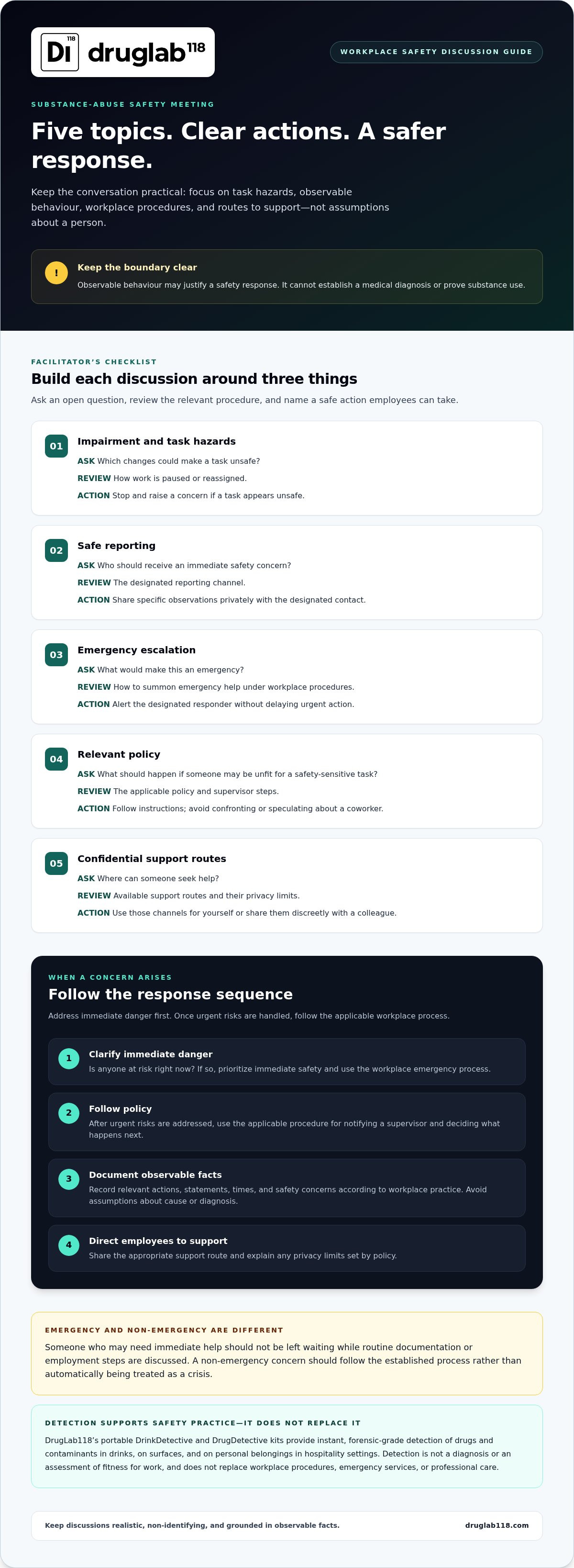
Observable behaviour may justify a safety response, but it cannot establish a medical diagnosis or prove substance use.
Set a respectful, safety-first frame
Use neutral language: describe what was seen or heard, identify the task-related concern, and review the applicable workplace procedure. For example, “I’m concerned you’re having difficulty keeping your balance near the loading area” is more useful than accusing someone of being intoxicated. Specific observations help protect both safety and dignity.
Tell employees to report urgent concerns promptly through the designated channel, rather than confronting someone publicly or discussing suspicions with coworkers. The next step is to reduce immediate danger and follow established procedures. Ask workers to share what they observed, not guesses about a colleague’s diagnosis, medication, or personal life. This makes reporting safer and more consistent.
Workplace Safety Meeting Topics on Substance Abuse: A Facilitator’s Checklist
Use the workplace safety meeting topics on substance abuse below as prompts, then tailor each discussion to actual job tasks, hazards, and workplace procedures. For every topic, pair an open question with a procedure to review and an action employees can take.
Turn each checklist item into a useful discussion
Keep scenarios realistic and non-identifying. For example, discuss what to do if a coworker appears unsteady before operating equipment, without suggesting a cause or naming a real employee. Review the organisation’s reporting, emergency, and support pathways. Explain that confidentiality is handled according to policy, rather than promising privacy without limits.
- Impairment and task hazards. Ask: “Which changes could make a task unsafe?” Review how work is paused or reassigned. Employees can stop and raise a concern if a task appears unsafe.
- Safe reporting. Ask: “Who should receive an immediate safety concern?” Review the reporting channel. Employees can share specific observations privately with the designated contact.
- Emergency escalation. Ask: “What would make this an emergency?” Review how to summon emergency help under workplace procedures. Employees can alert the designated responder without delaying urgent action.
- Relevant policy. Ask: “What should happen if someone may be unfit for a safety-sensitive task?” Review the applicable policy and supervisor steps. Employees can follow instructions and avoid confronting or speculating about a coworker.
- Confidential support routes. Ask: “Where can someone seek help?” Review available support routes and their privacy limits. Employees can use those channels for themselves or share them discreetly with a colleague.
For U.S. workplaces, review relevant guidance from OSHA, NIOSH, and SAMHSA, and have qualified legal counsel review policy questions. DrugLab118 also provides collaborative institutional briefings to support safety education as part of a broader prevention and response culture.
From Meeting Topics to a Visible, Supportive Safety Practice
A meeting creates value when its guidance carries into everyday decisions. Give employees and supervisors a simple sequence to follow when a concern arises:
- Clarify immediate danger. Is anyone at risk right now? If so, prioritize immediate safety and use the workplace emergency process.
- Follow policy. Once urgent risks are addressed, use the applicable procedure for notifying a supervisor and deciding what happens next.
- Document observable facts. Record relevant actions, statements, times, and safety concerns according to workplace practice. Avoid assumptions about cause or diagnosis.
- Direct employees to support. Share the appropriate confidential support route and explain any privacy limits set by policy.
Keep emergency response distinct from non-urgent performance or policy processes. A person who may need immediate help should not be left waiting while routine documentation or employment steps are discussed. A non-emergency concern, in turn, should follow the established process rather than automatically being treated as a crisis. Check each step against local requirements and applicable workplace policy.
Make detection and support part of the safety culture
DrugLab118’s approach connects anticipation, detection, support, and partnership. Institutions can use that continuum to consider risks in advance, make detection visible, connect people with appropriate support, and strengthen practice collaboratively. In hospitality settings, DrugLab118’s portable DrinkDetective and DrugDetective kits provide instant, forensic-grade detection of drugs and contaminants in drinks, on surfaces, and on personal belongings. They support detection, not a diagnosis or assessment of an employee’s fitness for work, and do not replace workplace procedures, emergency services, or professional care.
Visible, consistent safety practices can reinforce shared expectations, but they can’t guarantee a particular outcome. Review the process after meetings and incidents, then update guidance as workplace needs and risks change. For a broader perspective, explore institutional safety approaches.
Make the Next Safety Conversation Count
Start by reviewing how the meeting’s guidance works in practice. Are reporting routes clear? Do supervisors know which procedures apply? Can employees find support without being asked to explain more than necessary? These questions turn good intentions into a routine people understand and trust.
Workplace safety meeting topics on substance abuse are most effective when they lead to consistent, respectful action. Keep your organization’s procedures and people at the centre, and make prevention, detection, and support visible parts of ongoing safety planning.
Explore DrugLab118’s institutional briefings and detection solutions to support a workplace where prevention is visible and seeking support is possible.
Frequently Asked Questions
What topics should a workplace safety meeting cover about substance abuse?
Cover how substance-related concerns could intersect with specific work tasks, how employees can report concerns, what to do if someone needs urgent help, which workplace policies apply, and where support is available. The workplace safety meeting topics on substance abuse should also clarify who has authority to pause or reassign a task, so workers aren’t left guessing during a safety concern.
How can a supervisor discuss substance abuse without stigmatizing employees?
Discuss job safety and observed conduct, not labels or presumed causes. In a private conversation, a supervisor might say, “I noticed you missed two steps in the equipment check, and I’m concerned about the task’s safety.” Avoid asking coworkers to speculate, making public accusations, or treating a health condition as proof of impairment. Apply workplace procedures consistently.
How often should workplaces hold substance-related safety meetings?
There’s no single schedule that fits every workplace. Set a regular cadence based on the hazards, workforce needs, and existing safety program, then revisit the discussion when tasks, reporting routes, or relevant procedures change. A brief refresher during onboarding or after a process update can reinforce expectations, while routine safety meetings keep the topic from appearing only after an incident.
Can an employer require drug testing after a workplace safety meeting?
A meeting alone doesn’t determine whether testing can be required. The answer depends on the employer’s written policy, the circumstances, the worker’s role, and applicable laws or agreements. Before directing a test, responsible staff should follow established procedures and obtain qualified legal guidance where needed. Employees should be told what policy applies and how questions or concerns can be raised.


