

Every second of delay following a suspected narcotic exposure or a spiking incident is an invitation for evidence to vanish. In high-risk environments, the transition from a hidden threat to actionable data must be instantaneous. You can't afford to wait for laboratory confirmation when safety and legal integrity are on the line. Implementing robust on-site forensic drug screening isn't just a technical upgrade; it's a moral and institutional necessity. It's about protection. It's about certainty.
You've likely seen the consequences of delayed response times or the legal ambiguity that follows a loss of transient evidence. It's a frustrating gap in public safety that leaves organizations vulnerable. This definitive guide will empower you to master the technical and strategic principles of rapid identification to close that gap for good. We'll explore how to standardize safety protocols and utilize forensic-grade tools to secure immediate results. By the end of this analysis, you'll understand exactly how to transform your institution into a proactive guardian against illicit substances.
Key Takeaways
- Gain a technical understanding of colorimetric science to identify molecular signatures with forensic precision outside of a laboratory setting.
- Identify how on-site forensic drug screening serves as a critical first-response tool to capture evidence that would otherwise be lost to degradation or delayed response.
- Bridge the gap between immediate threat detection and long-term legal defensibility by maintaining a rigorous, real-time chain of custody.
- Implement standardized institutional protocols to protect high-risk environments through the strategic deployment of validated screening technologies.
- Master the transition from reactive observation to proactive safety using rapid identification tools designed for surfaces and liquid contaminants.
Understanding On-Site Forensic Drug Screening
On-site forensic drug screening is the immediate chemical analysis of suspected substances conducted within the environment where they're encountered. It bypasses the traditional, often catastrophic, delay of the laboratory. This isn't just a convenience. It's a fundamental shift in how we approach public safety. By identifying a threat the moment it's discovered, institutions move from a reactive posture to a proactive defense. Visibility is the first step toward control.
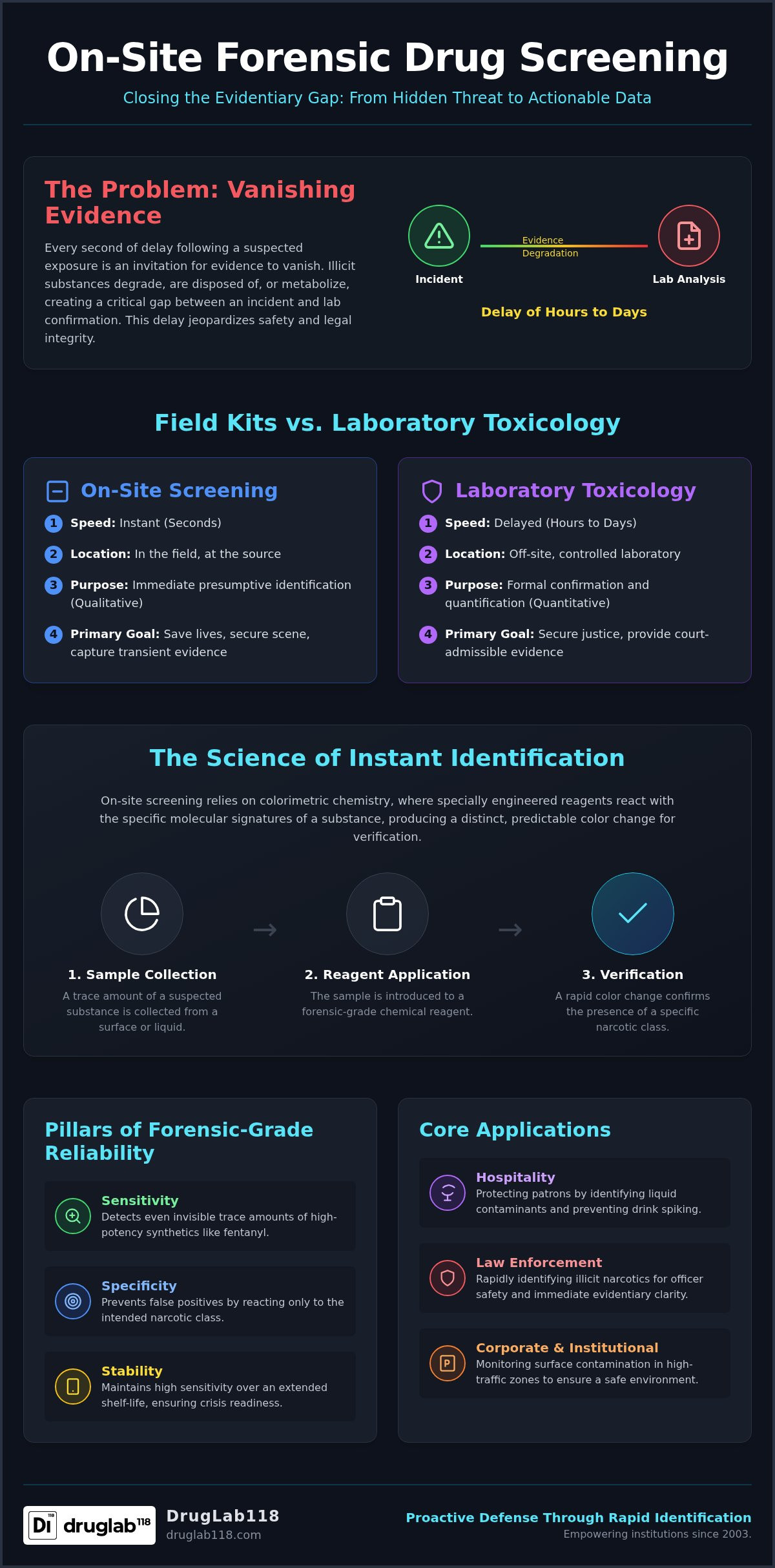
Historically, the field of forensic science relied almost exclusively on retrospective data. This Forensic Toxicology Overview illustrates how substances are analyzed for legal purposes, yet the standard model often fails to address the evidentiary gap created by substance degradation or disposal. On-site screening captures the truth before it vanishes. It's critical to distinguish between screening and confirmation. Screening provides an instant, qualitative identification of a substance's presence. Confirmation, conducted later via laboratory analysis, provides the quantitative depth required for formal prosecution. One saves lives. The other secures justice. Both are mandatory for a resilient safety protocol.
The Evolution of Portable Forensic Tools
The tools of the trade have undergone a radical transformation since DrugLab118 was established in 2003. We've moved from bulky, hazardous field kits to sophisticated, pocket-sized reagents that utilize high-sensitivity chemistry. These modern formulations allow for detection levels that were once the exclusive domain of the laboratory. This shift democratizes forensic safety. It empowers non-specialists to act as the first line of defense. When forensic-grade precision is portable, the window for illicit activity shrinks.
Core Applications in Public and Private Sectors
The deployment of on-site forensic drug screening spans every sector of modern society. In the hospitality industry, DrinkDetective serves as the definitive tool for identifying liquid contaminants, protecting patrons from the growing crisis of drink spiking. Law enforcement agencies rely on these technologies for the rapid identification of illicit narcotics during field operations, ensuring officer safety and immediate evidentiary clarity. In corporate and institutional settings, DrugDetective allows for the rigorous monitoring of surface contamination in high-traffic zones. This is how hidden threats become actionable data.
The Science of Instant Substance Identification
The effectiveness of on-site forensic drug screening rests upon the precision of colorimetric chemistry. These reagents are engineered to react with specific molecular signatures within a suspected substance. When a targeted compound is present, a distinct, predictable color change occurs. This is not a mere visual cue. It is a chemical verification. Validation. Certainty.
Achieving forensic-grade reliability requires a meticulous balance between sensitivity and specificity. Sensitivity ensures that even trace amounts of high-potency synthetics, such as fentanyl, are detected on surfaces where they remain invisible to the naked eye. Specificity prevents false positives by ensuring the reagent only responds to the intended narcotic class. Research into advances in field drug testing highlights how electrochemical and colorimetric sensors have evolved to handle complex matrices. Testing in alcohol or sugary sodas presents significant challenges. These liquids act as interfering matrices that can mask chemical reactions or trigger deceptive results. Sophisticated formulations are required to penetrate these barriers and reveal the hidden truth.
Reagent Integrity and Stability
Accuracy is a direct function of chemical stability. If a reagent degrades due to poor storage or inferior formulation, the result is compromised. DrugLab118 utilizes proprietary chemical formulations that maintain high sensitivity over an extended shelf-life. This ensures that when a crisis occurs, the tool is ready. Reliability is non-negotiable in high-stakes environments. For institutions looking to standardize their response, understanding these technical nuances is the first step toward implementing professional detection protocols that withstand scrutiny.
Detecting the "Invisible" Crisis
The most dangerous threats are often those that evade human senses. GHB, Ketamine, and Flunitrazepam are colorless, odorless, and tasteless. They leave no sensory trail for the victim or the observer. In these scenarios, the speed of reaction is the only viable defense. Instant results allow for immediate intervention before a patron is incapacitated or evidence is lost. On-site forensic drug screening transforms these hidden dangers into observable, actionable data. It provides the visibility needed to protect the vulnerable. Visibility saves lives. It closes the window of opportunity for those who seek to cause harm.
Field Kits vs. Laboratory Toxicology: Closing the Evidentiary Gap
The evidentiary gap is the silent enemy of justice. It represents the critical window between a suspected incident and the eventual laboratory result. During this interval, evidence degrades. Memory fades. Substances are metabolized. Relying solely on retrospective laboratory analysis often leads to a "no-result" outcome, leaving victims without answers and institutions without a defense. On-site forensic drug screening bridges this chasm. It captures the reality of the situation in real-time. Immediate. Decisive.
Maintaining a rigorous chain of custody begins the moment a substance is identified. On-site screening doesn't replace the lab; it preserves the narrative of the incident. By documenting a positive reaction at the scene, you create a verifiable record that justifies further investigation. This is a strategic necessity. It's about data integrity. When field results are used to direct laboratory resources, the entire forensic process becomes more efficient. You aren't just guessing. You're verifying. This approach reduces expensive lab overhead by ensuring only high-probability samples are submitted for confirmation.
Why Labs Often Fail Spiking Victims
Common spiking agents like GHB and Ketamine have notoriously short metabolic half-lives. If a victim isn't tested within a few hours, the substance often disappears from their system entirely. This is why retrospective blood tests so frequently fail. The psychological toll of waiting days for a negative result is devastating. DrinkDetective changes this dynamic by providing the immediate proof required for a police report. It validates the victim's experience instantly. Proof. Not promises.
Strategic Resource Allocation
Laboratory backlogs are a global crisis. Sending every suspicious sample for full toxicology is neither practical nor cost-effective. By using DrugDetective to screen out negative samples on-site, institutions can focus their financial resources on confirmed threats. This empowers non-scientists to act as a sophisticated first line of defense. It's a pragmatic approach to a volatile problem. You don't need a PhD to protect your environment. You need the right tools. Institutional reliability is built on these small, decisive actions. It's about creating a culture of safety that's both scientifically grounded and operationally efficient.
Implementing On-Site Protocols for Institutions
Adopting a forensic defense requires more than just acquiring tools. It demands a structured, institutionalized framework. To move from reactive chaos to controlled safety, organizations must implement a rigorous four-step protocol. This ensures that every instance of on-site forensic drug screening is conducted with scientific consistency and legal defensibility. Precision is the foundation of institutional trust.
- Step 1: Risk Assessment. Audit your physical environment to identify high-vulnerability zones. These are often areas where supervision is limited or transit volume is high. Blind spots are where threats reside.
- Step 2: Deployment. Integrate the hardware of detection into daily operations. Equip frontline staff with DrinkDetective for liquid analysis and DrugDetective for surface contamination monitoring. Accessibility is the key to rapid response.
- Step 3: Training. Standardize the response to a positive result. Staff must know exactly how to secure the scene, protect the individual, and preserve the sample for later laboratory confirmation. A test result without a protocol is a missed opportunity for safety.
- Step 4: Documentation. Every screening event must be logged. This data creates a historical record of threat patterns, which is essential for refining safety measures during institutional briefings and strategic planning.
Hospitality and Event Safety
For bar managers and event organizers, the duty of care is a legal and moral mandate. Integrating drink testing into standard safety measures transforms the venue from a target into a fortress. You must balance deterrence with privacy. Visible testing stations act as a powerful psychological barrier for potential offenders. Conversely, discreet testing options allow patrons to seek verification without public exposure. Both methods reinforce the institution's commitment to patron protection. Spiking isn't just a safety issue. It's a liability risk that demands a forensic solution.
Workplace and Transit Security
In corporate environments and public transit hubs, the focus shifts to surface integrity. Non-invasive screening of high-traffic surfaces can reveal the presence of high-potency synthetics before an accidental exposure occurs. This is about forensic intelligence. By monitoring these environments, security teams can develop a clear picture of illicit substance movement. This data is invaluable for law enforcement operations and internal safety audits. When you monitor the invisible, you protect the vulnerable. Institutional reliability is built on the ability to see what others miss. Visibility is safety. Data is defense.
The DrugLab118 Standard: Advanced Forensic Solutions
DrugLab118 has spent over two decades defining the parameters of modern substance identification. Established in 2003, our organization has evolved alongside the forensic industry, moving from traditional methodologies to the cutting edge of rapid response. We aren't just manufacturers. We're guardians of institutional integrity. By providing the tools for on-site forensic drug screening, we bridge the gap between suspicion and certainty. This is where clinical authority meets the real-world demand for immediate safety. Duty calls for a higher standard. We provide it.
Our flagship solutions are engineered for specific, high-stakes environments. DrinkDetective has become the definitive tool for identifying liquid contaminants, offering hospitality venues a way to combat the spiking crisis with scientific precision. For broader applications, DrugDetective provides professional-grade identification for surfaces and illicit substances. These aren't just kits. They're validated systems that show 97-100% agreement with GC/MS laboratory analysis. This level of accuracy ensures that your first response is grounded in traditional scientific rigor. It's about moving from hidden threats to observable, actionable data.
Proprietary Chemistry and White Label Excellence
The core of our reliability lies in our partnership with SureScreen Diagnostics Ltd. Together, we develop proprietary chemical formulations that serve as the foundation for global diagnostic standards. We offer these formulations through white-label chemical solutions, allowing other organizations to outsource forensic excellence without compromising on quality. This collaboration ensures that our diagnostics remain stable, sensitive, and capable of meeting the rigorous demands of international law and science. Validation is our currency. We don't just follow standards; we help set them. This ensures that every test performed is a step toward a safer society.
The Path Forward: Institutional Resilience
Technology alone is insufficient. Systemic change requires a synthesis of advanced tools and comprehensive education. Our Institutional Briefings are designed to bridge this operational gap, empowering decision-makers to manage substance exposure with confidence. We provide the intellectual framework needed to turn raw data into a shield for your organization. This isn't just about the science; it's about its ability to change behavior and improve institutional reliability. It's time to move beyond reactive measures and embrace a future of proactive protection. Secure your institution with DrugLab118 forensic tools and lead the charge for higher safety standards.
Establishing a Future of Forensic Certainty
The transition from a hidden threat to observable data is the only path to systemic resilience. By integrating on-site forensic drug screening into your institutional framework, you eliminate the dangerous delays of retrospective analysis. You move from a reactive posture to a position of clinical authority. Visibility is safety. Certainty is non-negotiable. This isn't just about chemistry; it's about the duty of care you owe to your patrons, staff, and the public.
Since 2003, DrugLab118 has led the charge for higher standards in rapid detection. Our proprietary technology, developed in partnership with SureScreen Diagnostics Ltd, is trusted by global law enforcement and hospitality leaders to close the evidentiary gap. You don't have to wait for the laboratory to act. You can protect your environment right now. We invite you to consult with our forensic experts to secure your organization and implement a defense grounded in scientific rigor. Take the first step toward a safer, more transparent future today.
Frequently Asked Questions
Is on-site forensic drug screening legally admissible in court?
On-site forensic drug screening results generally serve as presumptive evidence rather than final confirmatory proof in a court of law. They establish the immediate probable cause necessary for arrests or further investigation. While the gold standard remains laboratory based GC/MS analysis for formal prosecution, the field result is a critical component of the chain of custody. It documents the initial presence of a substance before degradation occurs, providing a scientifically grounded narrative for legal proceedings.
How accurate are DrinkDetective and DrugDetective compared to lab tests?
Both DrinkDetective and DrugDetective are engineered to achieve 97-100% agreement with GC/MS laboratory analysis. This high level of precision is the result of proprietary chemical formulations developed in partnership with SureScreen Diagnostics Ltd. While these tools provide qualitative identification rather than quantitative depth, their reliability ensures that frontline responders can act with total confidence. They bridge the gap between initial suspicion and the eventual, detailed laboratory confirmation required for justice.
Can these kits detect high-potency synthetic opioids like fentanyl?
Yes, our detection tools are specifically calibrated to identify high-potency synthetic opioids, including fentanyl and norfentanyl. The DrugDetective system utilizes high-sensitivity chemistry to detect trace amounts of these substances on surfaces that appear clean to the naked eye. This is a vital capability for officer safety and workplace protection. We also offer specialized combined tests that identify both fentanyl and xylazine, addressing the evolving landscape of synthetic narcotic threats.
What is the shelf life of a professional forensic screening kit?
Professional forensic screening kits typically maintain a shelf life of approximately 18 to 24 months when stored according to institutional standards. The proprietary chemistry used by DrugLab118 is formulated for maximum stability, ensuring that reagents remain sensitive and accurate throughout their lifecycle. Reliability is a non-negotiable requirement for field operations. Maintaining a fresh inventory of these tools is essential for organizations that prioritize immediate readiness and consistent institutional safety.
Do I need scientific training to use DrugLab118 detection tools?
Scientific training isn't required to operate these detection tools. We've designed the kits for intuitive use by frontline staff, security personnel, and hospitality workers. However, we strongly recommend our Institutional Briefings to ensure the technology is integrated correctly into broader safety protocols. These briefings teach staff how to interpret results and maintain the chain of custody. Understanding the "how" is simple, but mastering the "why" is what builds institutional resilience.
How does DrinkDetective handle different types of beverages?
DrinkDetective is engineered to function within complex liquid matrices, including alcohol, sugary sodas, and dairy products. These beverages often act as interfering agents that can mask traditional chemical reactions. Our proprietary reagents penetrate these barriers to identify molecular signatures of spiking agents like GHB and Ketamine without triggering false positives. This versatility makes it the global standard for hospitality safety. It provides visibility in environments where substances are designed to remain hidden.
Can DrugDetective identify substances on porous surfaces?
DrugDetective is effective at identifying substance residues on a wide variety of surfaces, including porous materials like fabric, wood, and concrete. The high-sensitivity reagents react to trace molecular signatures left behind by illicit powders or liquids. This capability is essential for monitoring high-traffic zones or transit hubs where environmental contamination is a risk. By detecting what's invisible to the human eye, you can proactively manage exposure risks and maintain a safer workplace environment.
What is an Institutional Substance Safety Briefing?
An Institutional Substance Safety Briefing is an expert-led session designed to bridge the gap between detection technology and operational safety. These briefings provide decision-makers and frontline staff with the intellectual framework needed to manage substance exposure effectively. We cover risk assessment, standardized response protocols, and the legal implications of screening results. This educational component ensures that the deployment of forensic tools results in a measurable, systemic improvement in public safety and institutional protection.


